
Lakewood Senior Scam Stopper
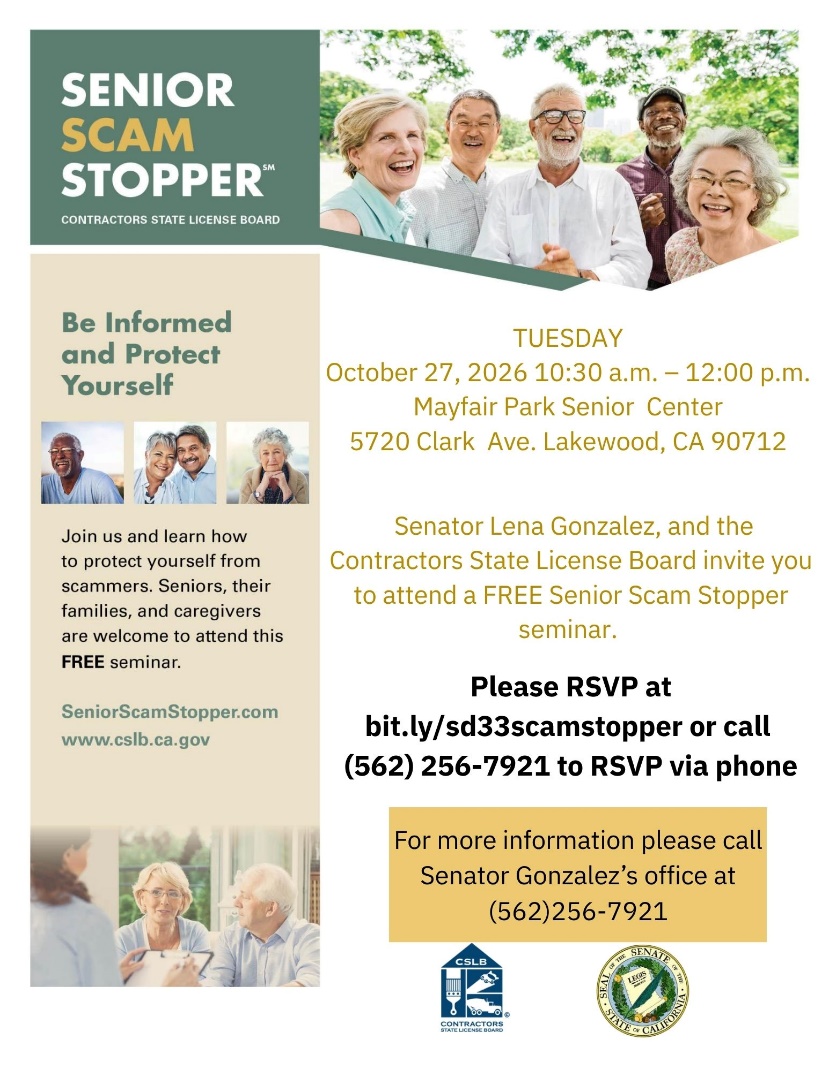
Senator Lena Gonzalez and the Contractors State License Board invite you to attend a FREE Senior Scam Stopper Seminar. This seminar will provide seniors and their families with valuable information and practical tools to help recognize, prevent, and avoid common scams and financial exploitation. Attendees will learn about California regulations, consumer protections, and preventative measures designed to help keep seniors safe from predatory contractors and other scams.
October 27, 2026 l 10:30 a.m. – 12:00 p.m.
Mayfair Park 5720 Clark Ave, Lakewood, CA 90712 (in the building directly next to the pool and closest to the intersection of Clark Ave. and South St.)
Parking is free in the parking lots at Mayfair Park. The closest lot to the event is located on the corner of Clark Ave. and South St.
Please click here to RSVP.
Bands at the Bandshell
October 2, 2026 l 7-9:00 p.m.
130 Cherry Ave, Long Beach, CA 90802
For more information, please visit the Bandshell Event page
Catalina Museum for Art and History Latino Heritage Celebration and Tamale Festival 2026
October 3, 2026 l 3-7 p.m.
For more information, please visit the Tamale Festival Event page.
Avalon Fall Carnival – City of Avalon
October 16th l 5pm – 8pm
Crescent Ave Avalon, CA 90704 (Front Street)
For more information, please visit the Avalon Fall Carnival page.
Cudahy Mercadito
Friday, October 16, 2026 l 6:00 p.m. - 9:00 p.m.
4835 Clara St, Cudahy, CA 90201
Annual Avalon Halloween Parade & Party
October 31, 2026 l 4:00 p.m. – 6:00 p.m.
For more information, please visit the Avalon Halloween Parade page.
Halloween Carnival and Dia De Muertos
October 31, 2026 l 5:00 p.m. - 9:00 p.m.
6662 Loveland St. Bell Gardens, California 90201
City of Paramount Halloween Festival
October 31, 2026 | 6:00 p.m. - 9:00 p.m.
14400 Paramount Blvd., Paramount, CA 90723
1 Million CalKIDS Accounts Claimed — Check If Your Family Qualifies
California has reached an exciting milestone: more than 1 million CalKIDS Scholarship Accounts have been claimed by students and families across the state. CalKIDS is a $2.4 billion state investment that helps California children build a financial foundation for education and career training after high school. Eligible public school students may receive up to $1,500, while every child born in California on or after July 1, 2022, is eligible for a scholarship of up to $175. If you have children, take a moment to see whether they have a CalKIDS account waiting to be claimed.
Check eligibility and claim your child’s account: CalKIDS.org
A New Way to Speak at LA County Board Meetings
Want to weigh in on an issue before the Los Angeles County Board of Supervisors? A new online registration system makes it easier to sign up for public comment before a meeting. You can register from any device, choose to speak in person or by phone, select the agenda item you want to address, and receive email or text reminders when it’s your turn to speak.
Register to speak at an upcoming Board meeting: PublicComment.LACounty.gov
For step-by-step instructions on registering and participating, view the LA County public comment guide.
Small Business Grants Available in Long Beach
The City’s Safe & Secure Grant Program provides eligible small businesses with up to $750 or $1,500 for security improvements such as cameras, lighting, alarm systems, and other eligible upgrades. The Visual Improvement Program also offers eligible businesses and nonprofits up to $1,000 to help repair storefront damage caused by vandalism or property crime.
See available grants, eligibility requirements, and how to apply. Please visit the Long Beach Small Business Grants page. For help with an application, businesses can contact the City’s BizCare Hotline at 562-570-4BIZ (4249).
Clean Transportation Funding Opportunities
New funding opportunities are available through INVEST CLEAN to support zero-emission transportation and charging infrastructure across the region. The Charging Infrastructure Incentive Program provides funding for heavy-duty truck charging infrastructure, with applications due January 13, 2027, while the Last Mile Freight Program supports replacing diesel Class 4–8 goods-movement trucks with battery-electric vehicles, with applications due October 5, 2026.
For more information on funding opportunities and eligibility, please visit the Invest Clean page.
LA28 Opens Applications for Local Food Businesses
LA28 has opened applications for its L.ocal A.uthentic Program, creating opportunities for hundreds of small and local food businesses, including food trucks, food carts, and pop-ups, to serve spectators during the 2028 Olympic and Paralympic Games. Selected businesses will also receive mentoring, tools and other support to prepare for Games-time operations while strengthening their capacity to grow and thrive beyond 2028. Applications are open September 10 through November 16.
Learn more and apply through RAMPLA’s LA28 L.ocal A.uthentic Program page.
LA County Housing Resources
If you or someone you know is struggling to stay housed, Los Angeles County offers free resources to help renters, homeowners, families, seniors, and fire survivors. Assistance may include rental and mortgage relief, utility assistance, legal assistance,eviction prevention, housing navigation, and other support to help residents remain safely housed.
Find housing assistance and see what resources you may qualify for at LA County Housing Stability Resources. If you need immediate assistance, call or text 2-1-1 for free, confidential, 24/7 information and referrals.
Prepare Now for El Niño and Winter Storms
With a potentially historical El Niño season ahead, now is the time to prepare your home and family for risks related to heavy rain, flooding, mudslides, and debris flows. Check your insurance coverage, clear gutters and drains, secure outdoor items, and make sure you have emergency supplies and important documents ready.State Actions to Prepare for El Niño
Governor Newsom has proclaimed a state of emergency to bolster statewide El Niño preparedness. The state of emergency helps California move faster to protect communities, stage critical resources, and strengthen readiness before severe weather intensifies. Among the actions ordered, the emergency proclamation directs state agencies to lead the state's flood-risk-reduction efforts, stage flood-fighting supplies such as sandbags and pumps, and pre-position other critical equipment. Caltrans will stage traffic-control, road-closure, and snow-removal equipment along the highways most at risk. The proclamation also prepares the California National Guard to support flood response, search-and-rescue, engineering, and logistics missions when needed. State environmental and natural resources agencies will support local efforts to prepare for flooding, landslides, and debris flows, by fast-tracking permitting and identifying other ways to cut red tape. Read the full proclamation here.
Local Actions and El Niño Resources
LA County
LA County Public Works crews prepare for storm season months in advance by inspecting dams and channels, removing debris and sediment from reservoirs, maintaining storm drains and pump stations and ensuring flood control facilities are ready before winter storms arrive. County teams are coordinating resources across departments and partners so they can respond quickly when conditions deteriorate.
LA County residents can visit the Public Works Sandbags Dashboard to find sandbag distribution locations and call (800) 933-0930 to speak to a Public Works engineer about property-specific preparation.
LA County is also taking steps to protect vulnerable residents.
- People experiencing homelessness are particularly vulnerable during severe rain, flooding, high winds, cold temperatures and other extreme weather. Homeless Services and Housing outreach teams are connecting unhoused neighbors to safe, warm shelter ahead of winter storms. 211 LA can help connect individuals with services and housing resources. Visit their website or call 2-1-1.
- LA County’s Aging & Disabilities Department is working to ensure older adults, who may face heightened risk during extreme weather, have the resources and support they need to prepare and stay safe.
For more information and resources, visit LA County's webpage for information about heavy rains and sign up for LA County's El Niño Preparedness Guide.
Long Beach
The City of Long Beach has a dedicated El Niño webpage with information on sandbags, how to prepare, forecasts, and more. Additionally, the City has proclaimed a local emergency as a result of the impacts from Hurricane Marie and the developing El Niño event and winter storm season. Read the full proclamation here.
How You Can Prepare for El Niño
Stay Informed
Sign up for Emergency Alerts
LA County: ready.lacounty.gov/emergency-notifications/
Long Beach: longbeach.gov/lgb/resources/emergency-alerts/
Cities, special districts, employers, schools and universities may each have their own emergency notification systems.
Find Helpful Resources
LA County has a dedicated webpage for information about heavy rains, providing rain safety tips, links to helpful resources, and information about how to make a safety plan. You can also sign up for LA County's El Niño Preparedness Guide to receive regular updates as El Niño season approaches.
For more information, please visit the SD33 El Niño Resource Page.
Voting FAQs & Resources
When is the deadline to Register to Vote?
The deadline to register for the November 3, 2026 Election is October 19, 2026.
Register here: https://registertovote.ca.gov. To register online you will need:
- Your California driver license or California identification card number,
- The last four digits of your social security number and
- Your date of birth.
What if I missed the deadline to register to vote?
If you missed the deadline to register to vote, you can use Same Day Voter Registration, known as Conditional Voter Registration in state law, which is a safety net for Californians who miss the deadline to register to vote or update their voter registration information for an election. If you are registering or re-registering less than 15 days before an election you will need to complete the Same-Day Voter Registration process.
Visit caearlyvoting.sos.ca.gov for a list of early voting locations where you can complete the Same Day Voter Registration Process.
Need to register on Election Day? Use our polling place lookup tool to find your local polling location.
Have additional questions about locations where you can complete the Same Day Voter Registration process? Contact your county elections office.
How do I check my voter registration status?
To check your voter registration status, visit: https://voterstatus.sos.ca.gov
For more election and voting information, visit my Voting FAQs Resource page.